
Why Privacy in AI Matters More Than Ever

As AI becomes deeply integrated into daily life, a critical question emerges: what happens to all the data these systems consume? From voice assistants to recommendation algorithms, modern AI is built on vast amounts of personal information. Understanding the privacy implications isn't optional anymore—it's essential.
Why Privacy Matters
Privacy in AI isn't just about keeping secrets. It's about maintaining control over digital identity. AI systems process everything from browsing patterns to biometric data, creating detailed profiles that reveal far more than any single data point would suggest.
The scale is staggering. A typical large language model trains on hundreds of billions of data points. Interactions with cloud-based AI services often become part of that training data—whether users realize it or not.
The Real Risks
Data Exposure: Centralized AI services create attractive targets. A single breach can expose millions of conversations, queries, and personal details simultaneously.
Inference Attacks: Even anonymized data can be de-anonymized. AI itself can reconstruct personal information from seemingly harmless metadata.
Model Memorization: Large language models can inadvertently memorize and reproduce sensitive information from their training data, including private conversations and personal details.
Behavioral Profiling: Continuous interaction with AI services generates behavioral patterns that can predict decisions, preferences, and vulnerabilities.
The Local Alternative
The architecture of AI deployment matters enormously for privacy. When AI runs locally on a device:
- Data never leaves the hardware
- No server logs capture queries
- No third party can access conversations
- Users maintain complete control over what the model sees
This isn't about having something to hide. It's about the principle that thoughts, questions, and creative explorations belong to the individual.
Privacy-First AI
AI capability and strong privacy aren't mutually exclusive. On-device processing through frameworks like Apple's MLX demonstrates that language models can run entirely locally, respecting the boundary between private digital life and external servers.
The future of AI should enhance human capability without compromising human autonomy.
Related posts

Enigmus 1.0: local LLMs on iPhone and iPad
Enigmus 1.0 is out on the App Store for iPhone and iPad. It runs large language models …
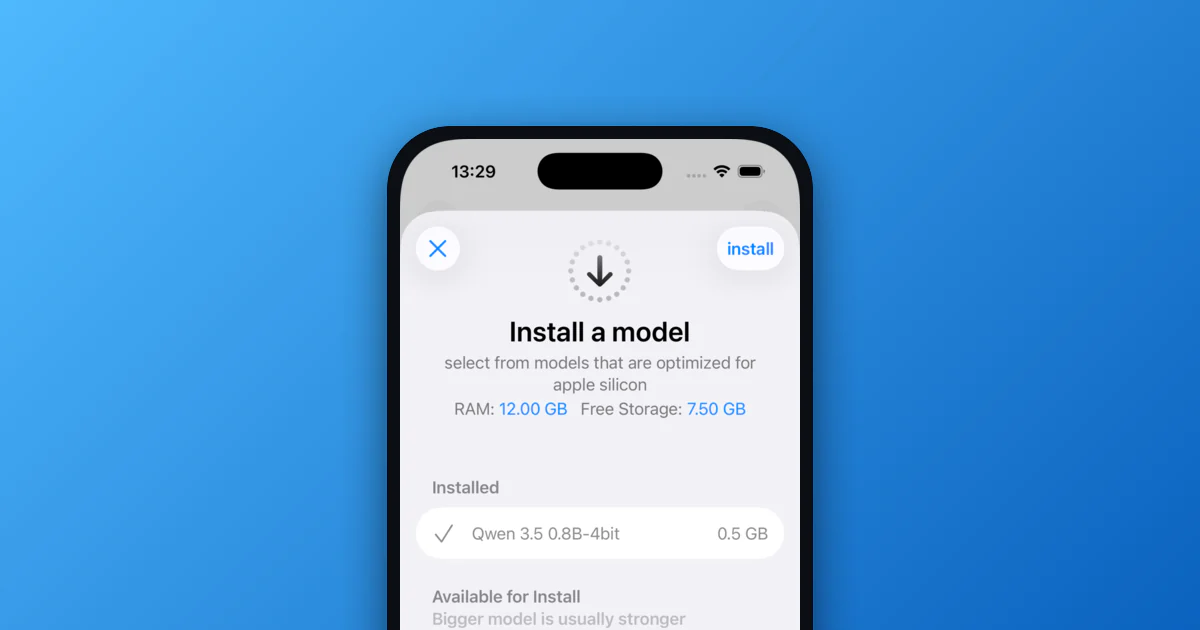
Enigmus 1.1.0: Gemma 4 on-device, and a compact text-only checkpoint
Enigmus 1.1.0 adds Google's Gemma 4 to the model picker across iPhone, iPad, and Mac. As with …
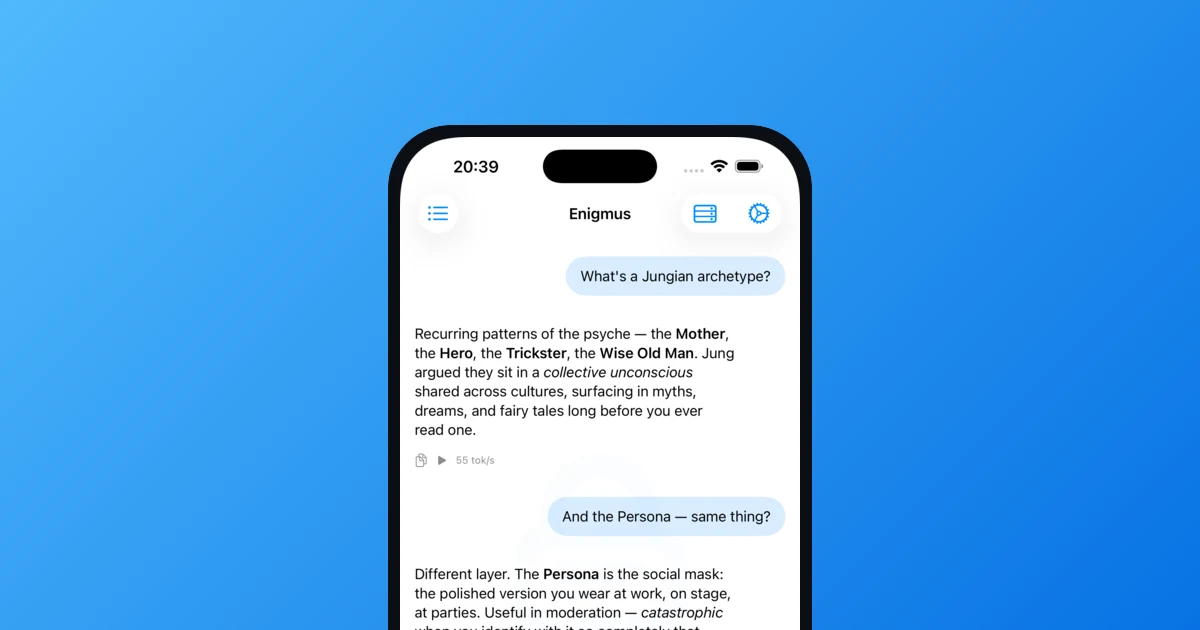
Enigmus 1.2: Qwen 3.5 and 3.6, and memory handling improvements
Enigmus runs open-weight language models entirely on device, on iPhone, iPad and Mac, with …